Let’s just start with a reminder of our minimum size guidelines:
A single enclosed area of at least 3m x 2m by 1m high.
This is for 2 average sized rabbits, so if you have giant breeds you will need to increase that.
If the shed is smaller than 3m x 2m shed to convert then you will still need to attach a permanent exercise run to it.
Benefits of a garden shed:
More protection from the weather. For both rabbits and owners who are cleaning out and feeding
More space for the rabbits than a hutch, so they can rear up fully, stretch out fully, and jump etc.
Starting out
Firstly decide how much room you have for the shed and the run. Remember that the run does not need to be right next to the shed if you are going to use a Runaround system to connect them.
Once you have ordered your shed and built it we recommend you line it. This will offer insulation but also stop the rabbit chewing through the shed, or a determined predator chewing in.
In this work-in-progress example we have lined the shed with plywood, and made a shelf which is accessed by the rabbits via some decking steps made to size. This gives the rabbits more floor space inside and offers them a more enriched environment.
If you use thicker plywood to line the shed it offers more protection, and you can put insulation between the shed and the plywood.
It is a good idea to line the shed (and shelf) with lino to protect it from urine and whatever else the rabbits get up to. You can add vet bed, large litter trays on top of that. Don’t forget to add the pop holes, Runaround connectors or cat flaps so that your rabbits can access their safe exercise area.
Once you have finished it might look something like this. Note that this shed has two Runaround holes. This is so that the rabbits, who have prey animal instincts feel safe and always have the option of two escape routes from the shed or run area.
Inside the converted shed
The shed was built and lined to provide insulation
Don’t forget the ventilation!
It is a good idea to make a secondary mesh door behind the shed door which you can open during the day, especially in nice weather, to make sure that the rabbits do not get too hot. Drilling holes or removing a horizontal beam of wood from the walls just under the eaves of the roof will provide an air outlet. An air inlet is also required and should be created at about half the shed’s height, this prevents the rabbits sitting in a draught. This could be made by replacing the window with mesh or in a similar fashion to the air inlet.
This way natural ventilation is created drawing air into the shed, removing ammonia (from rabbit urine) and heat travelling up and out through the air outlet. This is the best way to reduce respiratory disease (snuffles, pneumonia) where the main contributor is from exposure to high ammonia levels burning the respiratory system, allowing bacteria to then invade the respiratory tissues. You will know you have got good ventilation when you don’t see cobwebs building up. Remember to cover all air vents with wire mesh to prevent predator entry.
An example provided by Wood Green The Animals Charity.
As the example shows, you are going to need a safe enclosed exercise area which is accessible to them 24/7. If you are going to build your own exercise area, remember that they need a roof and a floor too.
Note on this example how there is a kickboard at the bottom so that you can open the door and walk in without the rabbits rushing out! This is a great idea and something to incorporate if you can. It will also offer more safety as it will prevent anything that has chewed the bottom of the shed door getting in, or the rabbits chewing out.
A converted shed with attached secure outside space
Escape and intruder proofing
Regardless of whether you buy or build an exercise area, if it is sited on grass then sink the wire under the earth so that the rabbits can not escape and a predator can not dig in to get them.
You might prefer to site it on paving stones or decking, if you do this then it is a nice idea to give them a grazing tray. In fact have two, so that one can be in with the rabbits and one can be growing again.
Security
The enclosure must be secure. If it’s outside, then it has to keep out foxes and other predators, so the mesh and bolts must be of good quality. Go for welded mesh of a heavy gauge, not chicken wire, which foxes can easily chew through. Use a bolt you can padlock.
Give a lot of thought to the wire mesh. There is a gauging system for thickness of wire and the lower the number, the thicker the wire. For example, a 16g wire (1.6mm) is stronger than a 19g wire (1mm). For fox proofing we would recommend using a minimum of 16g wire, as this is not only a stronger wire, but the greater surface area where the welds join make it more difficult for a fox to break the welds on the mesh. There is no published evidence to prove that 16g is fox proof, so we have to be practical in our recommendations and go with what we know works ‘in the field’.
“From our years of experience, we advise our customers to use 13mm hole welded mesh with a 16g wire as the perfect choice for fox-proof rabbit enclosures.” Dan Hancock, Managing Director, Mesh Direct.
Wire buried under grass to prevent digging out – or in
Turf trays allow rabbits access to fresh grass
Another consideration for your mesh is which hole size to go with. A 25mm hole is small enough to keep your rabbits inside, and with a 16g wire, this would also keep out foxes and polecats. We recommend keeping out smaller pests and predators such as rats, stoats, and weasels, so we suggest using a 13mm hole with a 16g wire.
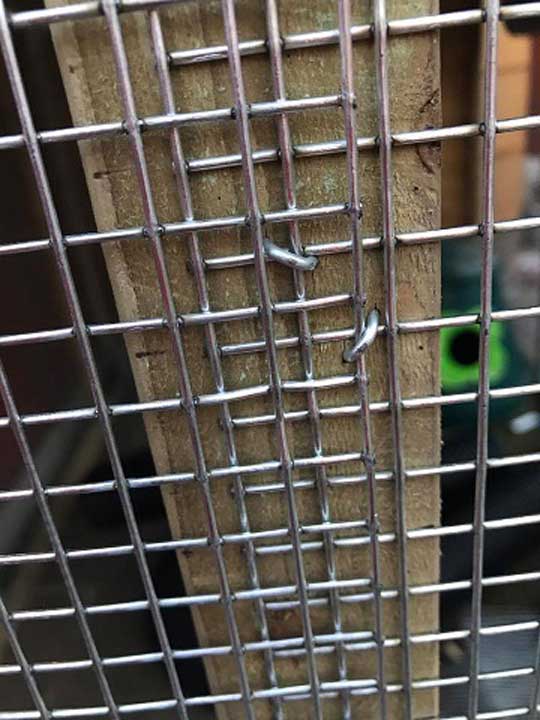
Ensure that the wire is properly fixed to the wood using either a staple tacker or hammer-in U-shaped staples.
Be aware of some exercise runs that have caused death or injury to the rabbits who have got their heads stuck in the mesh. This is particularly a risk where the mesh has a hole size which is larger than 25mm. Always read the reviews!
16g wire with 13mm holes
Rabbit accommodation with great enrichment
Voila!
This set up has everything in it that the rabbits would need. The shed is converted. There are 2 bolts on the door, top and bottom for extra security. We have used 12g 13mm wire attached by strong galvanised wire staples. There is a felt roof for protection and there is wire sunk under the grass area. There are 2 holes for entrance / exit between the shed and the exercise area.
Inside the run you will see we have given the rabbits:
Platforms to sit on and look for danger.
This also allows them to stretch and jump
Grass to graze and hay available at all times
Hiding places
A place to dig
Space to sit apart from each other if they want to
Plenty of space to run, jump and binky.
STEPtember Virtual Pack
London Marathon 2026, Own Place Registration
London Marathon 2026 - Own Place Registration
London Marathon 2026 Registration
Jump Through June Virtual Pack
Register for your fundraising pack
Great North Run, Own Place Registration
Great North Run Registration
This website uses cookies to ensure you get the best experience